.jpg)
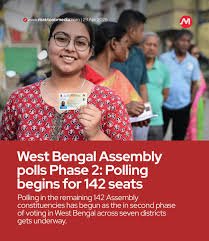


“West Bengal Elections 2026: Voting Underway for 142 Seats in Phase 2 Amidst Tight Security”
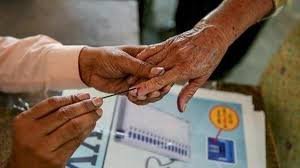
Voting for the second phase of the West Bengal Legislative Assembly Elections 2026 commenced today (April 29) at 7:00 AM. In this phase, voting is being held for a total of 142 seats across the state, with approximately 3.21 crore voters eligible to cast their ballots.
This election features a direct contest between the Trinamool Congress (TMC) and the Bharatiya Janata Party (BJP). Notably, in key constituencies such as Bhabanipur, the electoral battle between Chief Minister Mamata Banerjee and Leader of the Opposition Suvendu Adhikari has become a major topic of discussion.
More than 41,000 polling stations have been set up across the state to facilitate voting, and stringent security measures have been put in place. Thousands of units of central security forces have been deployed. Additionally, the voting process is being monitored through the use of drones and webcasting.
Long queues of voters have been visible at polling stations since early morning. The participation of women and the youth is particularly noticeable. Meanwhile, Prime Minister Narendra Modi has also appealed to citizens to turn out in large numbers to cast their votes.
Although reports of minor technical glitches with Electronic Voting Machines (EVMs) have emerged in a few isolated instances, the voting process is proceeding smoothly overall.
The voting in this phase is expected to have a significant impact on the political power dynamics within the state, and the final results are scheduled to be declared on May 4.
Voting for the second phase of the West Bengal Legislative Assembly Elections 2026 commenced today (April 29) at 7:00 AM. In this phase, voting is being held for a total of 142 seats across the state, with approximately 3.21 crore voters eligible to cast their ballots.
This election features a direct contest between the Trinamool Congress (TMC) and the Bharatiya Janata Party (BJP). Notably, in key constituencies such as Bhabanipur, the electoral battle between Chief Minister Mamata Banerjee and Leader of the Opposition Suvendu Adhikari has become a major topic of discussion.
More than 41,000 polling stations have been set up across the state to facilitate voting, and stringent security measures have been put in place. Thousands of units of central security forces have been deployed. Additionally, the voting process is being monitored through the use of drones and webcasting.
Long queues of voters have been visible at polling stations since early morning. The participation of women and the youth is particularly noticeable. Meanwhile, Prime Minister Narendra Modi has also appealed to citizens to turn out in large numbers to cast their votes.
Although reports of minor technical glitches with Electronic Voting Machines (EVMs) have emerged in a few isolated instances, the voting process is proceeding smoothly overall.
The voting in this phase is expected to have a significant impact on the political power dynamics within the state, and the final results are scheduled to be declared on May 4.
This election features a direct contest between the Trinamool Congress (TMC) and the Bharatiya Janata Party (BJP). Notably, in key constituencies such as Bhabanipur, the electoral battle between Chief Minister Mamata Banerjee and Leader of the Opposition Suvendu Adhikari has become a major topic of discussion.
More than 41,000 polling stations have been set up across the state to facilitate voting, and stringent security measures have been put in place. Thousands of units of central security forces have been deployed. Additionally, the voting process is being monitored through the use of drones and webcasting.
Long queues of voters have been visible at polling stations since early morning. The participation of women and the youth is particularly noticeable. Meanwhile, Prime Minister Narendra Modi has also appealed to citizens to turn out in large numbers to cast their votes.
Although reports of minor technical glitches with Electronic Voting Machines (EVMs) have emerged in a few isolated instances, the voting process is proceeding smoothly overall.
The voting in this phase is expected to have a significant impact on the political power dynamics within the state, and the final results are scheduled to be declared on May 4.