.jpg)


A New ‘Urban’ Face for Nagpur’s Policing!
- ‘Special-35’, 12 Nirbhaya Squads, CCTV at 1,500 locations; Priority on preventive action against crime.
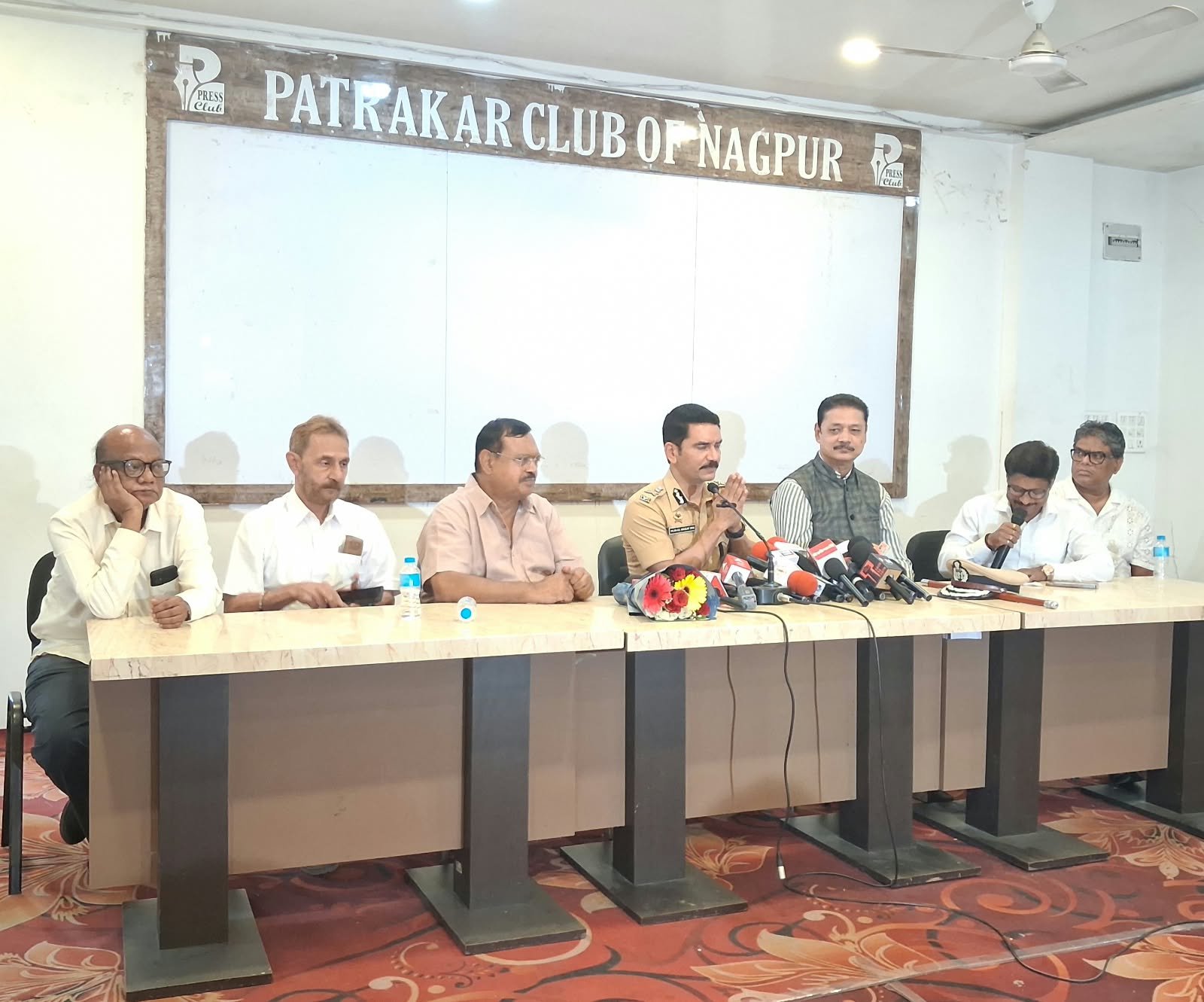
Nagpur, 8th (Correspondent): Nagpur City Police has devised a new ‘Urban Policing’ model with the objectives of anticipating crimes before they occur—in addition to pursuing criminals—bringing the police system closer to citizens, and monitoring every sensitive area of ??the city using technology. This was announced by Police Commissioner Vishwas Nangare Patil.
The Police Commissioner was speaking at an interaction with the press organized at the Press Club. At the beginning of the event, Pradeep Maitra (President, Press Club Nagpur), Brahma Tripathi (President, Nagpur Shramik Patrakar Sangh), and Shirish Borkar (General Secretary, Tilak Patrakar Bhavan Trust) welcomed Police Commissioner Vishwas Nangare Patil.
The Police Commissioner stated that a comprehensive strategy has been announced covering crime control, cyber fraud, drug trafficking, women's safety, traffic management, and preventive policing. Initiatives such as ‘Special-35’, 12 Nirbhaya squads, CCTV installation at approximately 1,500 new locations, three-tier patrolling, and a target of taking preventive action against 100 criminals at each Deputy Commissioner of Police (DCP) level will give Nagpur’s policing a more aggressive and technology-driven direction. Referring to the media as the fourth pillar of democracy, the Police Commissioner emphasized the need for the administration and the media to work in mutual cooperation for the public interest. He mentioned that a thorough study had been conducted over the past few months regarding the changing nature of Nagpur city, shifts in criminal modus operandi, and the citizens' growing expectations for safety. He explained that a new ‘urban policing model’ tailored to the city's needs is being developed, with the core objective of bringing the police closer to the citizens. A key feature of this new policing approach is crime prevention—acting before a crime occurs—rather than merely responding after the fact. A special system known as ‘Special-35’ has been established for the city's 35 police stations. Plainclothes police personnel will gather information regarding the nature of crime, suspicious activities, local criminals, and sensitive locations within each station's jurisdiction. A dedicated database covering approximately 90 parameters has been created for each police station; this includes data on crime rates, available manpower and resources, as well as complaints received via the emergency helpline number 112.
The police are also focusing intensely on the growing problem of narcotics. Beyond taking action against street-level peddlers, the police have adopted a strategy to identify and dismantle the major smugglers, suppliers, and organized networks behind the trade. Plans are in place to track down large drug syndicates and strike at their financial and organizational roots. The Police Commissioner stated that they are prepared to take preventive action against major smugglers by invoking the PIT-NDPS powers granted by the Maharashtra government.
Nagare Patil added that women's safety has been accorded high priority in this new policing model. Twelve ‘Nirbhaya Squads’ will be deployed across Nagpur city, with an emphasis on placing female police officers in leadership roles. These squads will be utilized more effectively to ensure the safety of women, girls, and vulnerable sections of society. Additionally, a comprehensive public awareness campaign will be launched to protect senior citizens from cyber fraud, particularly scams involving "digital arrest."
A distinct strategy has also been devised to optimize the utilization of police manpower. The plan entails deploying approximately 20 percent of the total police force to handle serious and major incidents, while the remaining 80 percent focuses on routine policing, patrolling, and citizen engagement. This approach aims to ensure that daily law and order and public safety remain uninterrupted, rather than the entire police machinery becoming preoccupied with a single major incident.
To enhance the effectiveness of the city's "beat system," emphasis will be placed on a three-tier patrolling model. Police presence will be stepped up across three levels: four-wheeler patrols on main roads, motorcycle patrols in narrow lanes and alleys, and foot patrols in residential neighborhoods and sensitive areas. The objective is to ensure police personnel are visibly present within communities, rather than merely driving around with sirens blaring. The city's surveillance infrastructure will also be strengthened through technology; plans are in place to install CCTV cameras at approximately 1,500 new locations and to reactivate cameras that are currently non-functional. The aim is to move beyond using CCTV solely for gathering evidence after a crime occurs, and instead utilize it more effectively for crime prevention, monitoring suspicious activity, and ensuring overall city safety.
Traffic management has also been prioritized within this new policing framework. Work is currently underway to integrate 1,170 junctions across Nagpur city into an "Integrated Traffic Management System." Efforts will be made to exercise more effective control over traffic congestion, accident-prone zones, and crowded areas by enhancing coordination between the traffic police and the local police.
As Nagpur hosts major religious, social, and cultural events, advance security planning will also be undertaken for large-scale festivals.
- ‘Special-35’, 12 Nirbhaya Squads, CCTV at 1,500 locations; Priority on preventive action against crime.
Nagpur, 8th (Correspondent): Nagpur City Police has devised a new ‘Urban Policing’ model with the objectives of anticipating crimes before they occur—in addition to pursuing criminals—bringing the police system closer to citizens, and monitoring every sensitive area of ??the city using technology. This was announced by Police Commissioner Vishwas Nangare Patil.
The Police Commissioner was speaking at an interaction with the press organized at the Press Club. At the beginning of the event, Pradeep Maitra (President, Press Club Nagpur), Brahma Tripathi (President, Nagpur Shramik Patrakar Sangh), and Shirish Borkar (General Secretary, Tilak Patrakar Bhavan Trust) welcomed Police Commissioner Vishwas Nangare Patil.
The Police Commissioner stated that a comprehensive strategy has been announced covering crime control, cyber fraud, drug trafficking, women's safety, traffic management, and preventive policing. Initiatives such as ‘Special-35’, 12 Nirbhaya squads, CCTV installation at approximately 1,500 new locations, three-tier patrolling, and a target of taking preventive action against 100 criminals at each Deputy Commissioner of Police (DCP) level will give Nagpur’s policing a more aggressive and technology-driven direction. Referring to the media as the fourth pillar of democracy, the Police Commissioner emphasized the need for the administration and the media to work in mutual cooperation for the public interest. He mentioned that a thorough study had been conducted over the past few months regarding the changing nature of Nagpur city, shifts in criminal modus operandi, and the citizens' growing expectations for safety. He explained that a new ‘urban policing model’ tailored to the city's needs is being developed, with the core objective of bringing the police closer to the citizens. A key feature of this new policing approach is crime prevention—acting before a crime occurs—rather than merely responding after the fact. A special system known as ‘Special-35’ has been established for the city's 35 police stations. Plainclothes police personnel will gather information regarding the nature of crime, suspicious activities, local criminals, and sensitive locations within each station's jurisdiction. A dedicated database covering approximately 90 parameters has been created for each police station; this includes data on crime rates, available manpower and resources, as well as complaints received via the emergency helpline number 112.
The police are also focusing intensely on the growing problem of narcotics. Beyond taking action against street-level peddlers, the police have adopted a strategy to identify and dismantle the major smugglers, suppliers, and organized networks behind the trade. Plans are in place to track down large drug syndicates and strike at their financial and organizational roots. The Police Commissioner stated that they are prepared to take preventive action against major smugglers by invoking the PIT-NDPS powers granted by the Maharashtra government.
Nagare Patil added that women's safety has been accorded high priority in this new policing model. Twelve ‘Nirbhaya Squads’ will be deployed across Nagpur city, with an emphasis on placing female police officers in leadership roles. These squads will be utilized more effectively to ensure the safety of women, girls, and vulnerable sections of society. Additionally, a comprehensive public awareness campaign will be launched to protect senior citizens from cyber fraud, particularly scams involving "digital arrest."
A distinct strategy has also been devised to optimize the utilization of police manpower. The plan entails deploying approximately 20 percent of the total police force to handle serious and major incidents, while the remaining 80 percent focuses on routine policing, patrolling, and citizen engagement. This approach aims to ensure that daily law and order and public safety remain uninterrupted, rather than the entire police machinery becoming preoccupied with a single major incident.
To enhance the effectiveness of the city's "beat system," emphasis will be placed on a three-tier patrolling model. Police presence will be stepped up across three levels: four-wheeler patrols on main roads, motorcycle patrols in narrow lanes and alleys, and foot patrols in residential neighborhoods and sensitive areas. The objective is to ensure police personnel are visibly present within communities, rather than merely driving around with sirens blaring. The city's surveillance infrastructure will also be strengthened through technology; plans are in place to install CCTV cameras at approximately 1,500 new locations and to reactivate cameras that are currently non-functional. The aim is to move beyond using CCTV solely for gathering evidence after a crime occurs, and instead utilize it more effectively for crime prevention, monitoring suspicious activity, and ensuring overall city safety.
Traffic management has also been prioritized within this new policing framework. Work is currently underway to integrate 1,170 junctions across Nagpur city into an "Integrated Traffic Management System." Efforts will be made to exercise more effective control over traffic congestion, accident-prone zones, and crowded areas by enhancing coordination between the traffic police and the local police.
As Nagpur hosts major religious, social, and cultural events, advance security planning will also be undertaken for large-scale festivals.
Nagpur, 8th (Correspondent): Nagpur City Police has devised a new ‘Urban Policing’ model with the objectives of anticipating crimes before they occur—in addition to pursuing criminals—bringing the police system closer to citizens, and monitoring every sensitive area of ??the city using technology. This was announced by Police Commissioner Vishwas Nangare Patil.
The Police Commissioner was speaking at an interaction with the press organized at the Press Club. At the beginning of the event, Pradeep Maitra (President, Press Club Nagpur), Brahma Tripathi (President, Nagpur Shramik Patrakar Sangh), and Shirish Borkar (General Secretary, Tilak Patrakar Bhavan Trust) welcomed Police Commissioner Vishwas Nangare Patil.
The Police Commissioner stated that a comprehensive strategy has been announced covering crime control, cyber fraud, drug trafficking, women's safety, traffic management, and preventive policing. Initiatives such as ‘Special-35’, 12 Nirbhaya squads, CCTV installation at approximately 1,500 new locations, three-tier patrolling, and a target of taking preventive action against 100 criminals at each Deputy Commissioner of Police (DCP) level will give Nagpur’s policing a more aggressive and technology-driven direction. Referring to the media as the fourth pillar of democracy, the Police Commissioner emphasized the need for the administration and the media to work in mutual cooperation for the public interest. He mentioned that a thorough study had been conducted over the past few months regarding the changing nature of Nagpur city, shifts in criminal modus operandi, and the citizens' growing expectations for safety. He explained that a new ‘urban policing model’ tailored to the city's needs is being developed, with the core objective of bringing the police closer to the citizens. A key feature of this new policing approach is crime prevention—acting before a crime occurs—rather than merely responding after the fact. A special system known as ‘Special-35’ has been established for the city's 35 police stations. Plainclothes police personnel will gather information regarding the nature of crime, suspicious activities, local criminals, and sensitive locations within each station's jurisdiction. A dedicated database covering approximately 90 parameters has been created for each police station; this includes data on crime rates, available manpower and resources, as well as complaints received via the emergency helpline number 112.
The police are also focusing intensely on the growing problem of narcotics. Beyond taking action against street-level peddlers, the police have adopted a strategy to identify and dismantle the major smugglers, suppliers, and organized networks behind the trade. Plans are in place to track down large drug syndicates and strike at their financial and organizational roots. The Police Commissioner stated that they are prepared to take preventive action against major smugglers by invoking the PIT-NDPS powers granted by the Maharashtra government.
Nagare Patil added that women's safety has been accorded high priority in this new policing model. Twelve ‘Nirbhaya Squads’ will be deployed across Nagpur city, with an emphasis on placing female police officers in leadership roles. These squads will be utilized more effectively to ensure the safety of women, girls, and vulnerable sections of society. Additionally, a comprehensive public awareness campaign will be launched to protect senior citizens from cyber fraud, particularly scams involving "digital arrest."
A distinct strategy has also been devised to optimize the utilization of police manpower. The plan entails deploying approximately 20 percent of the total police force to handle serious and major incidents, while the remaining 80 percent focuses on routine policing, patrolling, and citizen engagement. This approach aims to ensure that daily law and order and public safety remain uninterrupted, rather than the entire police machinery becoming preoccupied with a single major incident.
To enhance the effectiveness of the city's "beat system," emphasis will be placed on a three-tier patrolling model. Police presence will be stepped up across three levels: four-wheeler patrols on main roads, motorcycle patrols in narrow lanes and alleys, and foot patrols in residential neighborhoods and sensitive areas. The objective is to ensure police personnel are visibly present within communities, rather than merely driving around with sirens blaring. The city's surveillance infrastructure will also be strengthened through technology; plans are in place to install CCTV cameras at approximately 1,500 new locations and to reactivate cameras that are currently non-functional. The aim is to move beyond using CCTV solely for gathering evidence after a crime occurs, and instead utilize it more effectively for crime prevention, monitoring suspicious activity, and ensuring overall city safety.
Traffic management has also been prioritized within this new policing framework. Work is currently underway to integrate 1,170 junctions across Nagpur city into an "Integrated Traffic Management System." Efforts will be made to exercise more effective control over traffic congestion, accident-prone zones, and crowded areas by enhancing coordination between the traffic police and the local police.
As Nagpur hosts major religious, social, and cultural events, advance security planning will also be undertaken for large-scale festivals.