.jpg)
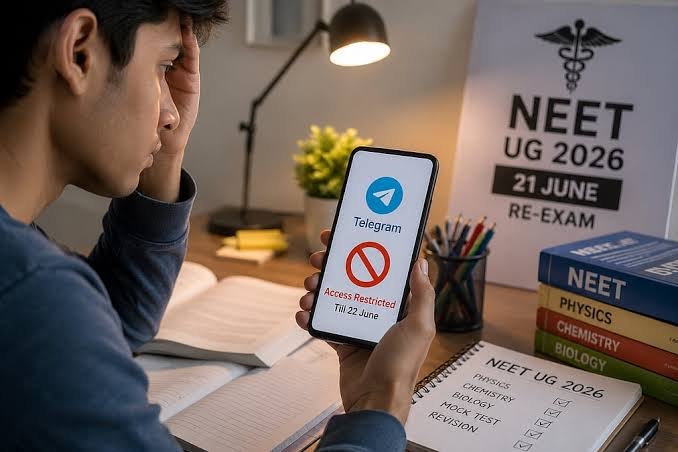


Ban on Telegram to Prevent NEET Paper Leaks Upheld; Major Decision by Delhi High Court
New Delhi: Messaging app Telegram has suffered a major setback from the Delhi High Court just days before the re-examination of the medical entrance test, NEET-UG. The court has fully upheld the temporary ban imposed by the Central Government.
On Friday (June 19, 2026), a vacation bench led by Justice Tejas Karia dismissed Telegram's petition, which had challenged the government's decision.
Court's Verdict
The court clarified that under Section 69A of the Information Technology Act, the Central Government possesses full authority to ban any digital platform in the interest of national security and public order. The court observed that the step taken by the government to prevent the leakage of question papers and the dissemination of related material prior to the NEET exam was justified and necessary.
The court stated that both government orders were based on solid grounds and confirmed that due process had been followed. It rejected Telegram's argument that "sufficient information had not been provided."
Background of the Case
The Central Government had imposed a temporary ban on Telegram amidst serious concerns regarding question paper leaks in the NEET exam. The government informed the court that this urgent decision was essential to safeguard the future of lakhs of students.
Telegram had argued that while specific objectionable content could be blocked, banning the entire app was unjustified. However, the Delhi High Court upheld the government's stance and dismissed the company's petition.
Significance
This decision is considered crucial for maintaining the transparency of national-level examinations like NEET. It reaffirms the government's authority to regulate digital platforms under Section 69A of the IT Act.
New Delhi: Messaging app Telegram has suffered a major setback from the Delhi High Court just days before the re-examination of the medical entrance test, NEET-UG. The court has fully upheld the temporary ban imposed by the Central Government.
On Friday (June 19, 2026), a vacation bench led by Justice Tejas Karia dismissed Telegram's petition, which had challenged the government's decision.
Court's Verdict
The court clarified that under Section 69A of the Information Technology Act, the Central Government possesses full authority to ban any digital platform in the interest of national security and public order. The court observed that the step taken by the government to prevent the leakage of question papers and the dissemination of related material prior to the NEET exam was justified and necessary.
The court stated that both government orders were based on solid grounds and confirmed that due process had been followed. It rejected Telegram's argument that "sufficient information had not been provided."
Background of the Case
The Central Government had imposed a temporary ban on Telegram amidst serious concerns regarding question paper leaks in the NEET exam. The government informed the court that this urgent decision was essential to safeguard the future of lakhs of students.
Telegram had argued that while specific objectionable content could be blocked, banning the entire app was unjustified. However, the Delhi High Court upheld the government's stance and dismissed the company's petition.
Significance
This decision is considered crucial for maintaining the transparency of national-level examinations like NEET. It reaffirms the government's authority to regulate digital platforms under Section 69A of the IT Act.
On Friday (June 19, 2026), a vacation bench led by Justice Tejas Karia dismissed Telegram's petition, which had challenged the government's decision.
Court's Verdict
The court clarified that under Section 69A of the Information Technology Act, the Central Government possesses full authority to ban any digital platform in the interest of national security and public order. The court observed that the step taken by the government to prevent the leakage of question papers and the dissemination of related material prior to the NEET exam was justified and necessary.
The court stated that both government orders were based on solid grounds and confirmed that due process had been followed. It rejected Telegram's argument that "sufficient information had not been provided."
Background of the Case
The Central Government had imposed a temporary ban on Telegram amidst serious concerns regarding question paper leaks in the NEET exam. The government informed the court that this urgent decision was essential to safeguard the future of lakhs of students.
Telegram had argued that while specific objectionable content could be blocked, banning the entire app was unjustified. However, the Delhi High Court upheld the government's stance and dismissed the company's petition.
Significance
This decision is considered crucial for maintaining the transparency of national-level examinations like NEET. It reaffirms the government's authority to regulate digital platforms under Section 69A of the IT Act.