Severe Drought Impact in Solapur! Farmers Forced to Sell Milch Cattle Worth ?1.5 Lakh for Just ?30,000; Central Team Conducts Inspections
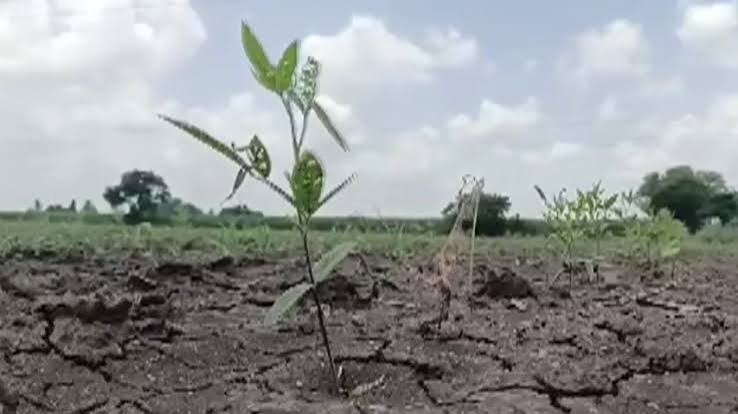
Solapur: The situation in Solapur district has become critical due to a lack of rainfall, plunging the region into a drought crisis. Farmers are in distress as the scarcity of water and fodder worsens; they have voiced their anguish over being forced to sell milch livestock—valued at ?1.5 lakh—for a pittance of ?25,000 to ?30,000. Against this backdrop, an Inter-Ministerial Central Drought Team arrived in the district on Friday after concluding a tour of Ahilyanagar and conducted on-site inspections of the damage in Barshi and North Solapur talukas. Subsequently, during a meeting at the District Collector's office that lasted until late Friday night, the team directed the administration to complete the assessment of crop losses promptly and accurately. The team, led by Dr. K. Ponnusami (Director, Union Department of Agriculture and Farmers Welfare), includes Absar Ahmed Khan and Sumit Sharma. The team conducted a comprehensive review covering damage to Kharif crops and orchards (such as pomegranate and grapes), the decline in groundwater levels over the past five years, and water storage levels in the Ujani dam as well as medium and minor irrigation projects. On Saturday (the 10th) at 8:30 AM, the central committee is scheduled to tour the North Solapur, Mangalvedha, and Sangola talukas of the district. They will visit and inspect various locations in these three talukas to assess the situation regarding agriculture, drinking water, livestock fodder, the condition of farm laborers, and the functioning of ration shops. Additionally, during the drought inspection tour, there will be further interaction with some farmers in the district for the second consecutive day. All 11 *talukas* are drought-affected; soybean production has dropped by 87 percent. District Collector S. Karthikeyan presented the grim reality of the district during a meeting. Compared to the average rainfall of 481.10 mm for the June-September period, the district received only 244.70 mm (50.90 percent), leading to the declaration of all 11 *talukas* as drought-affected. A prolonged dry spell occurred in 99 out of the district's 110 revenue circles. Crop-cutting experiments revealed massive declines in productivity: 87.4 percent for soybean, 69.3 percent for *moong* (green gram), 64.32 percent for *urad* (black gram), 52.2 percent for pearl millet (*bajra*), and 31.2 percent for maize. Currently, 62 percent of the damage assessment surveys (*panchanamas*) have been completed, and the remaining work is proceeding rapidly. Groundwater levels have depleted; fodder stocks will last only 47 days. The district's groundwater level has dropped by 2.98 meters compared to the five-year average. Although the Ujani Dam holds 85.17 percent of its water capacity, storage levels are critically low at just 4.14 percent in 56 minor irrigation projects and 21.52 percent in seven medium irrigation projects. Water is currently being supplied to 116 villages via 108 tankers. Meanwhile, the available fodder for the district's livestock population of 1,817,652 is sufficient for an average of only 47 days. To address this, a provision of ?5 crore has been made through the District Planning Committee (DPC) for fodder seeds, with a target to produce 214,000 metric tonnes of fodder. The District Collector clarified that the upcoming sugarcane crushing season would make sugarcane tops available as fodder. To curb migration, work under the ‘Viksit Bharat-Employment and Livelihood Mission’ (Rural) is being accelerated to prevent laborers from leaving rural areas due to the drought. Currently, 12,718 laborers are engaged in 3,273 projects across 453 villages, and a shelf of projects planning for 6.4 million (64 lakh) man-days is ready. Additionally, a campaign to desilt 100 lakes—at a rate of 10 per taluka—will be undertaken through CSR initiatives. Agriculture Commissioner Suraj Mandhare urged officials to demonstrate the same sensitivity shown during the COVID-19 pandemic, stating, "We must step up to tackle the drought with the same spirit of sensitivity and promptness that the administration displayed during the COVID period. While meticulously planning for water and fodder, it is essential to plug leaks in water supply systems and raise public awareness." The central committee commended the district administration's planning and instructed them to immediately submit an objective report on the extent of the damage.

.jpg)