.jpg)
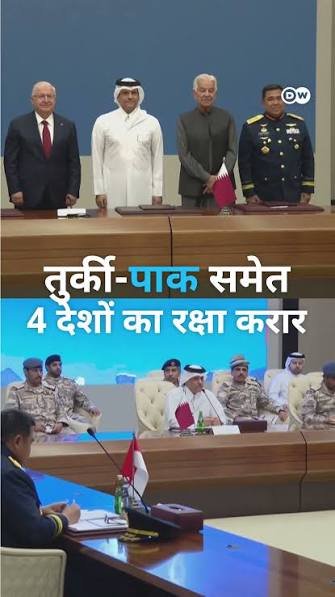


A New Alliance Emerges: Pakistan, Turkey, Qatar, and Indonesia Forge a Pact, Sidelining Saudi Arabia; ‘Badr Agreement’ Signed in Doha.
Doha: Joint Production of Advanced Weaponry. A significant development, poised to reshape defense equations across the Middle East and Asia, has come to light. Four major Muslim-majority nations—Pakistan, Turkey, Qatar, and Indonesia—have taken a historic decision to jointly produce lethal weaponry and modern military systems. Representatives from these four countries signed a multilateral defense pact, dubbed the ‘Badr Agreement,’ in Doha, the capital of Qatar. Beyond the mere manufacturing of arms, the agreement encompasses the exchange of cutting-edge military technology, collaborative research, and specialized training programs within the defense sector. Following the ‘Mecca Agreement,’ this rapidly deepening partnership between Pakistan and various Gulf and Muslim nations signals the emergence of a new, globally significant military alliance. Combining the strengths of four nations: who holds what responsibility? According to an analysis by defense expert Arda Mevlutoglu, each of these four nations brings distinct advantages that complement one another:
Turkey – Expertise in the design of modern weaponry, advanced drones, combat aircraft, and a sophisticated, well-developed defense industry.
Pakistan and Indonesia – Large-scale manufacturing facilities, an abundant and cost-effective workforce, and a substantial domestic market.
Qatar – Vast capital for comprehensive defense projects, direct investment, and the capacity to purchase finished military products.
This partnership is set to provide Turkish defense firms with long-term orders while reducing production costs; simultaneously, it will create new employment opportunities in Pakistan and Indonesia and facilitate the transfer of technology. Accelerating existing initiatives, this agreement will bring several ongoing bilateral projects under a single, unified framework. Pakistan and Turkey are jointly building four state-of-the-art warships (two in Istanbul and two at the Karachi Shipyard). Indonesia and Turkey are collaborating on a tank-manufacturing project. For over a decade, Qatar has been making significant investments in Turkey’s defense industry. The primary objective behind this alignment—according to international analysts—is to completely end the reliance on the United States and Western nations for weaponry. In the event of a war or diplomatic disagreement, the U.S. could potentially withhold the supply of spare parts and ammunition, or impose restrictions on the use of technology. This initiative seeks to build a self-reliant defense ecosystem to mitigate such risks. Regarding the distinction between the ‘Mecca Agreement’ and the ‘Badr Agreement’: The Mecca Agreement—involving Saudi Arabia, Pakistan, and Turkey—is primarily based on the principle of ‘collective security’ (where an attack on one nation is considered an attack on all three). In contrast, the Badr Agreement, concluded in Doha in October 2026, is an industrial pact focused specifically on arms production, technology exchange, and the expansion of the defense industry; notably, Saudi Arabia has been deliberately excluded from this agreement.