.jpg)


A National Unity Government or a Power Grab? Three Paths to Forming a Government in Israel
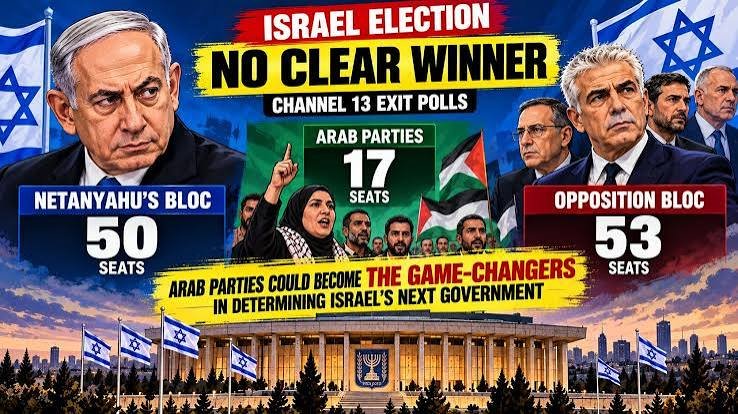
Israel Election News: Following the recent elections in Israel, a deadlock has emerged as no single party or coalition secured a clear majority. President Isaac Herzog has invited Gadi Eisenkot—whose bloc won the highest number of seats—to form a government. To reach the required majority, Eisenkot has offered his staunch rival, Benjamin Netanyahu, an opportunity to join the government. This presents Netanyahu with three primary options. In Israel’s 120-member parliament (Knesset), a majority of 61 seats is required to form a government. Eisenkot’s four-party coalition holds 48 seats, while Netanyahu’s right-wing alliance holds 53. Since Eisenkot has ruled out including Arab parties, bringing in Netanyahu’s Likud party has emerged as a key possibility. 1. An All-Party Government under Eisenkot’s Leadership
Eisenkot has proposed setting aside political differences to form a "National Emergency Unity Government." He has invited both Netanyahu’s Likud party and Bezalel Smotrich to join. Eisenkot’s position is that the government would operate under his leadership and adhere to specific, agreed-upon principles. Netanyahu has been offered the position of Foreign Minister or Defense Minister—but this would require him to relinquish the post of Prime Minister. Analysts believe it is highly unlikely that Netanyahu will accept, as he has never held a secondary role while in power. Furthermore, he is currently facing ongoing legal proceedings. 2. Agreement to Share the Premiership
A second option is to divide the term of the premiership, similar to the agreement reached between Netanyahu and Benny Gantz in 2020. An arrangement could be made where Eizenkot holds the office for the first two years, followed by Netanyahu for the remaining two—or vice versa. This would allow both leaders an equal share of the term. However, given past experience—specifically when Netanyahu paved the way for new elections before handing over the premiership to Gantz—this option might face opposition from Eizenkot’s allies. 3. Securing Power by Splintering Eizenkot’s Coalition
Instead of joining a government, Netanyahu could attempt to cause a split within Eizenkot’s coalition by swaying some members of parliament to his side. He would only need the support of eight additional lawmakers to secure a majority. Eizenkot has been granted a period of 28 to 42 days to form a government; during this time, Netanyahu could exert pressure by leveraging his powers as the caretaker Prime Minister. Should an Eizenkot-Netanyahu unity government be formed, Arab parties (holding 19 seats) could emerge as the primary opposition. Furthermore, right-wing factions—such as those led by Smotrich and Ben-Gvir—along with some of Eizenkot’s own allies, might also end up on the opposition benches. Consequently, both the government and the opposition could end up comprising groups with diametrically opposed ideologies. The process of government formation in Israel remains uncertain, and the coming days will prove to be decisive.