.jpg)


Supreme Court grants relief to woman excluded from police constable post due to 'squint eyes'; orders her appointment
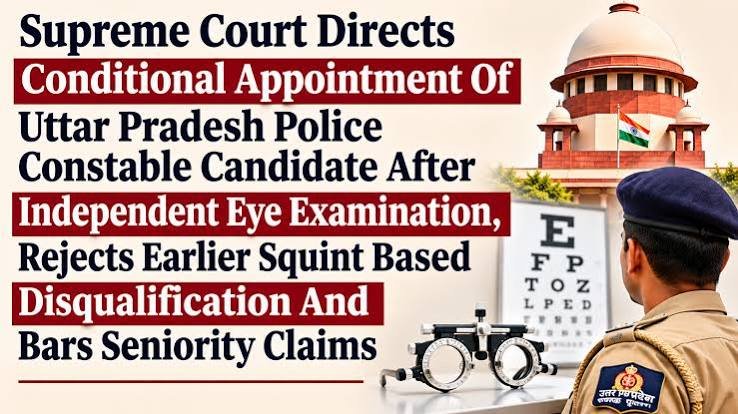
Lucknow / New Delhi: The Supreme Court has provided significant relief to a woman who was declared medically unfit for a Uttar Pradesh Police Constable position—despite passing all other recruitment tests—on the grounds that she had a "squint" (strabismus). The Court has directed the state government to appoint her. Akanksha Devi had applied under the Uttar Pradesh Police Constable Civil Direct Recruitment 2023. She successfully cleared the document verification and physical fitness tests; however, during a medical examination in April 2025, she was declared unfit due to a "squint." A re-examination yielded the same conclusion, and she was not even provided with a written order regarding this decision. Akanksha Devi subsequently sought examinations from two ophthalmologists in Kanpur, both of whom certified that her vision was normal. Despite this, her application remained rejected. She then filed a petition with the Allahabad High Court, which dismissed the case on the grounds that the recruitment process had already concluded. Following this, Akanksha Devi approached the Supreme Court. A bench comprising Justice Arvind Kumar and Justice Vipul M. Pancholi intervened, ordering an independent medical evaluation by a board of ophthalmologists at King George’s Medical University (KGMU), Lucknow. The examination, conducted in October 2026, confirmed that she had 6/6 vision in both eyes, with normal ocular movement and all other parameters within the normal range. Based on this report, the Supreme Court delivered a verdict on November 2, 2026, setting aside the order of the Allahabad High Court. The court stated, “Since the medical board of KGMU has certified that the vision is proper and normal, we set aside the impugned order and allow the petition. The respondents are directed to issue an appointment order or call letter, provided the petitioner is otherwise eligible. However, the petitioner shall not claim seniority over candidates who have already been appointed.” This decision is likely to provide relief to other candidates who may have faced injustice during their medical examinations.
Lucknow / New Delhi: The Supreme Court has provided significant relief to a woman who was declared medically unfit for a Uttar Pradesh Police Constable position—despite passing all other recruitment tests—on the grounds that she had a "squint" (strabismus). The Court has directed the state government to appoint her. Akanksha Devi had applied under the Uttar Pradesh Police Constable Civil Direct Recruitment 2023. She successfully cleared the document verification and physical fitness tests; however, during a medical examination in April 2025, she was declared unfit due to a "squint." A re-examination yielded the same conclusion, and she was not even provided with a written order regarding this decision. Akanksha Devi subsequently sought examinations from two ophthalmologists in Kanpur, both of whom certified that her vision was normal. Despite this, her application remained rejected. She then filed a petition with the Allahabad High Court, which dismissed the case on the grounds that the recruitment process had already concluded. Following this, Akanksha Devi approached the Supreme Court. A bench comprising Justice Arvind Kumar and Justice Vipul M. Pancholi intervened, ordering an independent medical evaluation by a board of ophthalmologists at King George’s Medical University (KGMU), Lucknow. The examination, conducted in October 2026, confirmed that she had 6/6 vision in both eyes, with normal ocular movement and all other parameters within the normal range. Based on this report, the Supreme Court delivered a verdict on November 2, 2026, setting aside the order of the Allahabad High Court. The court stated, “Since the medical board of KGMU has certified that the vision is proper and normal, we set aside the impugned order and allow the petition. The respondents are directed to issue an appointment order or call letter, provided the petitioner is otherwise eligible. However, the petitioner shall not claim seniority over candidates who have already been appointed.” This decision is likely to provide relief to other candidates who may have faced injustice during their medical examinations.
Lucknow / New Delhi: The Supreme Court has provided significant relief to a woman who was declared medically unfit for a Uttar Pradesh Police Constable position—despite passing all other recruitment tests—on the grounds that she had a "squint" (strabismus). The Court has directed the state government to appoint her. Akanksha Devi had applied under the Uttar Pradesh Police Constable Civil Direct Recruitment 2023. She successfully cleared the document verification and physical fitness tests; however, during a medical examination in April 2025, she was declared unfit due to a "squint." A re-examination yielded the same conclusion, and she was not even provided with a written order regarding this decision. Akanksha Devi subsequently sought examinations from two ophthalmologists in Kanpur, both of whom certified that her vision was normal. Despite this, her application remained rejected. She then filed a petition with the Allahabad High Court, which dismissed the case on the grounds that the recruitment process had already concluded. Following this, Akanksha Devi approached the Supreme Court. A bench comprising Justice Arvind Kumar and Justice Vipul M. Pancholi intervened, ordering an independent medical evaluation by a board of ophthalmologists at King George’s Medical University (KGMU), Lucknow. The examination, conducted in October 2026, confirmed that she had 6/6 vision in both eyes, with normal ocular movement and all other parameters within the normal range. Based on this report, the Supreme Court delivered a verdict on November 2, 2026, setting aside the order of the Allahabad High Court. The court stated, “Since the medical board of KGMU has certified that the vision is proper and normal, we set aside the impugned order and allow the petition. The respondents are directed to issue an appointment order or call letter, provided the petitioner is otherwise eligible. However, the petitioner shall not claim seniority over candidates who have already been appointed.” This decision is likely to provide relief to other candidates who may have faced injustice during their medical examinations.