.jpg)


Iran's New Maneuver: 'Dangerous Zone' Marked in Strait of Hormuz; Tankers Mandated to Contact Iranian Navy
Dubai/Tehran: Iran's Islamic Revolutionary Guard Corps (IRGC) on Thursday released a map identifying areas within the Strait of Hormuz where naval mines were laid during wartime. This map has caused a global stir, as Iran once again sends shockwaves across the world.
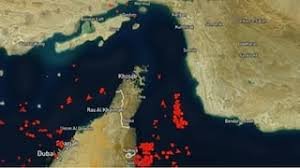
The map was published by Iran's semi-official news agencies, ISNA and Tasnim. It marks the main shipping lanes within the Strait of Hormuz as a "Dangerous Zone" in Persian. Iran has advised oil tankers to navigate closer to the Iranian coastline—specifically via a more northerly route (near Larak Island)—rather than following the route along the Omani coast. To do so, vessels have been informed that coordinating with the Iranian Navy is mandatory.
The Strait of Hormuz is a critical maritime choke point for the global trade of oil and natural gas. Approximately 20 percent of the world's total oil trade passes through this strait. This latest move by Iran poses a significant threat to international trade and energy security.
Impact on Shipping:
According to data from Kepler, a vessel-tracking firm, only four ships transited through this route on the first day following the announcement. Many vessels traveled with their tracking systems switched off—operating as a "dark fleet." Currently, approximately 230 oil tankers are waiting to exit the strait. Iran has now imposed new conditions on this route, including the potential levying of a "toll" (fee) and the requirement for vessels to establish contact with its navy. Pressure on the U.S.:
These moves by Iran are exerting direct pressure on the United States. U.S. President Donald Trump recently held discussions with NATO Secretary General Mark Rutte. Subsequently, while sharply criticizing NATO, Trump stated, "NATO was not with us when we needed it; nor will it be needed in the future." As tensions surrounding Iran escalate, there is speculation that U.S.-NATO relations could also be adversely affected.
It appears that Iran has adopted this strategy to secure control over the Strait of Hormuz in the event of a conflict. Global oil prices have already risen, and fears are being expressed that this map could further exacerbate the situation.
Dubai/Tehran: Iran's Islamic Revolutionary Guard Corps (IRGC) on Thursday released a map identifying areas within the Strait of Hormuz where naval mines were laid during wartime. This map has caused a global stir, as Iran once again sends shockwaves across the world.
The map was published by Iran's semi-official news agencies, ISNA and Tasnim. It marks the main shipping lanes within the Strait of Hormuz as a "Dangerous Zone" in Persian. Iran has advised oil tankers to navigate closer to the Iranian coastline—specifically via a more northerly route (near Larak Island)—rather than following the route along the Omani coast. To do so, vessels have been informed that coordinating with the Iranian Navy is mandatory.
The Strait of Hormuz is a critical maritime choke point for the global trade of oil and natural gas. Approximately 20 percent of the world's total oil trade passes through this strait. This latest move by Iran poses a significant threat to international trade and energy security.
Impact on Shipping:
According to data from Kepler, a vessel-tracking firm, only four ships transited through this route on the first day following the announcement. Many vessels traveled with their tracking systems switched off—operating as a "dark fleet." Currently, approximately 230 oil tankers are waiting to exit the strait. Iran has now imposed new conditions on this route, including the potential levying of a "toll" (fee) and the requirement for vessels to establish contact with its navy. Pressure on the U.S.:
These moves by Iran are exerting direct pressure on the United States. U.S. President Donald Trump recently held discussions with NATO Secretary General Mark Rutte. Subsequently, while sharply criticizing NATO, Trump stated, "NATO was not with us when we needed it; nor will it be needed in the future." As tensions surrounding Iran escalate, there is speculation that U.S.-NATO relations could also be adversely affected.
It appears that Iran has adopted this strategy to secure control over the Strait of Hormuz in the event of a conflict. Global oil prices have already risen, and fears are being expressed that this map could further exacerbate the situation.
The map was published by Iran's semi-official news agencies, ISNA and Tasnim. It marks the main shipping lanes within the Strait of Hormuz as a "Dangerous Zone" in Persian. Iran has advised oil tankers to navigate closer to the Iranian coastline—specifically via a more northerly route (near Larak Island)—rather than following the route along the Omani coast. To do so, vessels have been informed that coordinating with the Iranian Navy is mandatory.
The Strait of Hormuz is a critical maritime choke point for the global trade of oil and natural gas. Approximately 20 percent of the world's total oil trade passes through this strait. This latest move by Iran poses a significant threat to international trade and energy security.
Impact on Shipping:
According to data from Kepler, a vessel-tracking firm, only four ships transited through this route on the first day following the announcement. Many vessels traveled with their tracking systems switched off—operating as a "dark fleet." Currently, approximately 230 oil tankers are waiting to exit the strait. Iran has now imposed new conditions on this route, including the potential levying of a "toll" (fee) and the requirement for vessels to establish contact with its navy. Pressure on the U.S.:
These moves by Iran are exerting direct pressure on the United States. U.S. President Donald Trump recently held discussions with NATO Secretary General Mark Rutte. Subsequently, while sharply criticizing NATO, Trump stated, "NATO was not with us when we needed it; nor will it be needed in the future." As tensions surrounding Iran escalate, there is speculation that U.S.-NATO relations could also be adversely affected.
It appears that Iran has adopted this strategy to secure control over the Strait of Hormuz in the event of a conflict. Global oil prices have already risen, and fears are being expressed that this map could further exacerbate the situation.