.jpg)
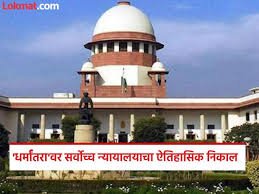


Supreme Court's Landmark Verdict: Christian Pastor Denied Scheduled Caste Protection
New Delhi/Andhra Pradesh: The Supreme Court has upheld a significant ruling by the Andhra Pradesh High Court. According to this decision, an individual who has embraced Christianity and actively practices the faith cannot continue to be considered part of the Scheduled Caste (SC) community.
A bench comprising Justice P.K. Mishra and Justice N.V. Anjaria clarified that, pursuant to the Constitution (Scheduled Castes) Order, 1950, only individuals professing the Hindu, Sikh, or Buddhist faiths are eligible to claim Scheduled Caste status and avail themselves of the associated reservation benefits. Conversion to any other religion results in the immediate and complete cessation of one's original caste status.
**Background of the Case**
This case arose from an appeal filed by an individual named Chinthada Anand from Andhra Pradesh. Anand has been practicing Christianity for the past ten years and serves as a pastor in a church. He had lodged a complaint under the Scheduled Castes and Scheduled Tribes (Prevention of Atrocities) Act, alleging caste-based abuse and threats. However, the Andhra Pradesh High Court had quashed this FIR on April 30, 2025.
The High Court had observed that the caste system is alien to Christianity and that a convert forfeits their original caste status. The Supreme Court fully upheld this decision.
**Key Observations by the Court**
If an individual actively practices Christianity following their conversion, they cannot be deemed a Scheduled Caste member.
The constitutional provision in this regard is absolute and admits of no exceptions.
Mere possession of a caste certificate obtained by birth does not entitle a convert to protection under the SC/ST Act.
This verdict is considered to have far-reaching implications regarding reservation policies and the issue of religious conversion. It is likely to trigger fresh debates and discussions across numerous related cases.
New Delhi/Andhra Pradesh: The Supreme Court has upheld a significant ruling by the Andhra Pradesh High Court. According to this decision, an individual who has embraced Christianity and actively practices the faith cannot continue to be considered part of the Scheduled Caste (SC) community.
A bench comprising Justice P.K. Mishra and Justice N.V. Anjaria clarified that, pursuant to the Constitution (Scheduled Castes) Order, 1950, only individuals professing the Hindu, Sikh, or Buddhist faiths are eligible to claim Scheduled Caste status and avail themselves of the associated reservation benefits. Conversion to any other religion results in the immediate and complete cessation of one's original caste status.
**Background of the Case**
This case arose from an appeal filed by an individual named Chinthada Anand from Andhra Pradesh. Anand has been practicing Christianity for the past ten years and serves as a pastor in a church. He had lodged a complaint under the Scheduled Castes and Scheduled Tribes (Prevention of Atrocities) Act, alleging caste-based abuse and threats. However, the Andhra Pradesh High Court had quashed this FIR on April 30, 2025.
The High Court had observed that the caste system is alien to Christianity and that a convert forfeits their original caste status. The Supreme Court fully upheld this decision.
**Key Observations by the Court**
If an individual actively practices Christianity following their conversion, they cannot be deemed a Scheduled Caste member.
The constitutional provision in this regard is absolute and admits of no exceptions.
Mere possession of a caste certificate obtained by birth does not entitle a convert to protection under the SC/ST Act.
This verdict is considered to have far-reaching implications regarding reservation policies and the issue of religious conversion. It is likely to trigger fresh debates and discussions across numerous related cases.
A bench comprising Justice P.K. Mishra and Justice N.V. Anjaria clarified that, pursuant to the Constitution (Scheduled Castes) Order, 1950, only individuals professing the Hindu, Sikh, or Buddhist faiths are eligible to claim Scheduled Caste status and avail themselves of the associated reservation benefits. Conversion to any other religion results in the immediate and complete cessation of one's original caste status.
**Background of the Case**
This case arose from an appeal filed by an individual named Chinthada Anand from Andhra Pradesh. Anand has been practicing Christianity for the past ten years and serves as a pastor in a church. He had lodged a complaint under the Scheduled Castes and Scheduled Tribes (Prevention of Atrocities) Act, alleging caste-based abuse and threats. However, the Andhra Pradesh High Court had quashed this FIR on April 30, 2025.
The High Court had observed that the caste system is alien to Christianity and that a convert forfeits their original caste status. The Supreme Court fully upheld this decision.
**Key Observations by the Court**
If an individual actively practices Christianity following their conversion, they cannot be deemed a Scheduled Caste member.
The constitutional provision in this regard is absolute and admits of no exceptions.
Mere possession of a caste certificate obtained by birth does not entitle a convert to protection under the SC/ST Act.
This verdict is considered to have far-reaching implications regarding reservation policies and the issue of religious conversion. It is likely to trigger fresh debates and discussions across numerous related cases.