.jpg)
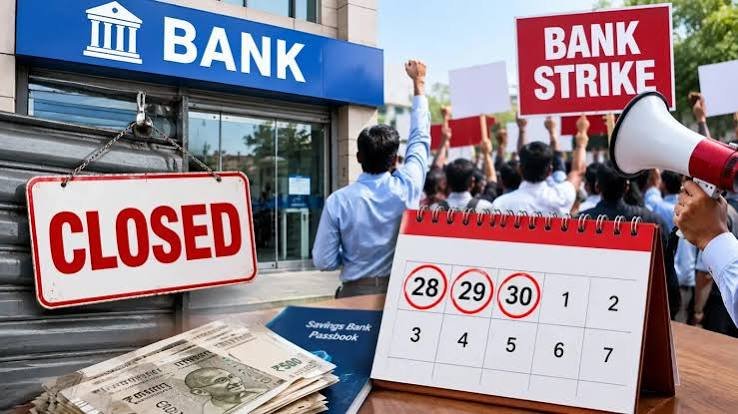


Banks to remain closed for five consecutive days due to a three-day strike and holidays; fears of financial transactions stalling
Pune: The United Forum of Bank Unions has called for a three-day nationwide strike on September 28, 29, and 30 to press for the key demand of immediately implementing a five-day work week in the banking sector. With public sector and nationalized banks set to remain closed for five consecutive days—due to the strike coinciding with preceding holidays—there are concerns that financial transactions could come to a standstill.
September 26 (the fourth Saturday) and September 27 (Sunday) are holidays, followed immediately by the proposed strike from September 28 to 30. If the strike proceeds at full scale, in-person banking services at branches are likely to face significant disruptions during this five-day period. Various banks have advised customers to complete essential branch-based transactions in advance.
In light of the proposed strike, the Union Finance Ministry has directed public sector banks and Regional Rural Banks to make necessary arrangements to keep banking services as smooth as possible and to ensure sufficient cash availability in ATMs. The State Bank of India has stated that it is taking necessary steps to maintain essential services.
Meanwhile, the National Organization of Bank Workers and the National Organization of Bank Officers—both affiliated with the Bharatiya Mazdoor Sangh—will not participate in this three-day strike. Acknowledging the five-day work week as a legitimate and long-pending demand of bank employees, Rajesh Mule, General Secretary of the State Bank Workers Organization, stated that dialogue with the Central Government is ongoing; he expressed confidence that a positive decision would be reached through discussions and that five-day banking would soon be implemented.
As efforts will be made to keep branch services operational through employees not participating in the strike, the three-day protest is likely to receive a mixed response. Efforts will be made to keep cash transactions and other essential services operational in many places. Rajesh Mule stated that customers would face no inconvenience if they utilized ATMs, cash deposit machines, internet banking, and other digital platforms.
Pune: The United Forum of Bank Unions has called for a three-day nationwide strike on September 28, 29, and 30 to press for the key demand of immediately implementing a five-day work week in the banking sector. With public sector and nationalized banks set to remain closed for five consecutive days—due to the strike coinciding with preceding holidays—there are concerns that financial transactions could come to a standstill.
September 26 (the fourth Saturday) and September 27 (Sunday) are holidays, followed immediately by the proposed strike from September 28 to 30. If the strike proceeds at full scale, in-person banking services at branches are likely to face significant disruptions during this five-day period. Various banks have advised customers to complete essential branch-based transactions in advance.
In light of the proposed strike, the Union Finance Ministry has directed public sector banks and Regional Rural Banks to make necessary arrangements to keep banking services as smooth as possible and to ensure sufficient cash availability in ATMs. The State Bank of India has stated that it is taking necessary steps to maintain essential services.
Meanwhile, the National Organization of Bank Workers and the National Organization of Bank Officers—both affiliated with the Bharatiya Mazdoor Sangh—will not participate in this three-day strike. Acknowledging the five-day work week as a legitimate and long-pending demand of bank employees, Rajesh Mule, General Secretary of the State Bank Workers Organization, stated that dialogue with the Central Government is ongoing; he expressed confidence that a positive decision would be reached through discussions and that five-day banking would soon be implemented.
As efforts will be made to keep branch services operational through employees not participating in the strike, the three-day protest is likely to receive a mixed response. Efforts will be made to keep cash transactions and other essential services operational in many places. Rajesh Mule stated that customers would face no inconvenience if they utilized ATMs, cash deposit machines, internet banking, and other digital platforms.
September 26 (the fourth Saturday) and September 27 (Sunday) are holidays, followed immediately by the proposed strike from September 28 to 30. If the strike proceeds at full scale, in-person banking services at branches are likely to face significant disruptions during this five-day period. Various banks have advised customers to complete essential branch-based transactions in advance.
In light of the proposed strike, the Union Finance Ministry has directed public sector banks and Regional Rural Banks to make necessary arrangements to keep banking services as smooth as possible and to ensure sufficient cash availability in ATMs. The State Bank of India has stated that it is taking necessary steps to maintain essential services.
Meanwhile, the National Organization of Bank Workers and the National Organization of Bank Officers—both affiliated with the Bharatiya Mazdoor Sangh—will not participate in this three-day strike. Acknowledging the five-day work week as a legitimate and long-pending demand of bank employees, Rajesh Mule, General Secretary of the State Bank Workers Organization, stated that dialogue with the Central Government is ongoing; he expressed confidence that a positive decision would be reached through discussions and that five-day banking would soon be implemented.
As efforts will be made to keep branch services operational through employees not participating in the strike, the three-day protest is likely to receive a mixed response. Efforts will be made to keep cash transactions and other essential services operational in many places. Rajesh Mule stated that customers would face no inconvenience if they utilized ATMs, cash deposit machines, internet banking, and other digital platforms.